Native desktop architecture
이 콘텐츠는 아직 번역되지 않았습니다.
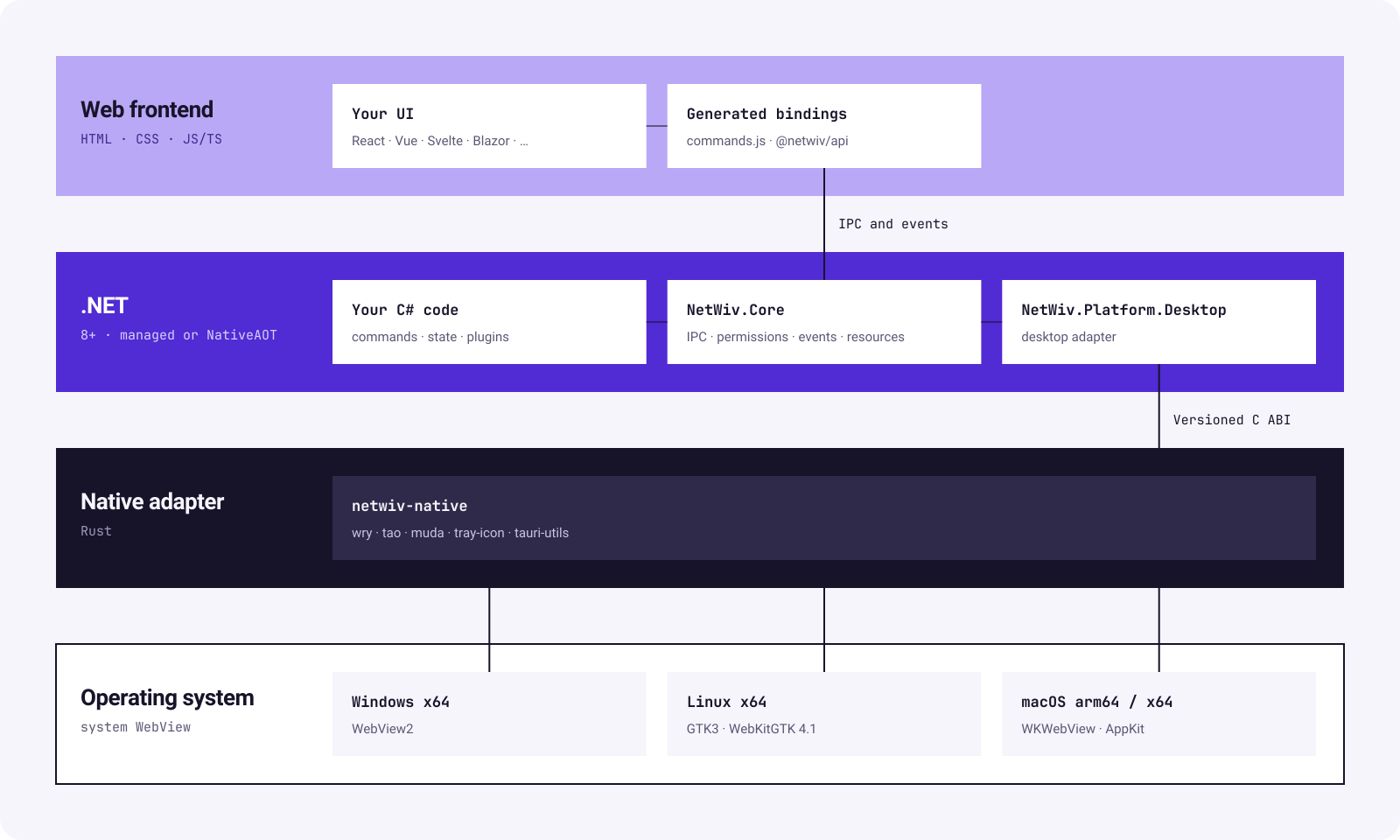
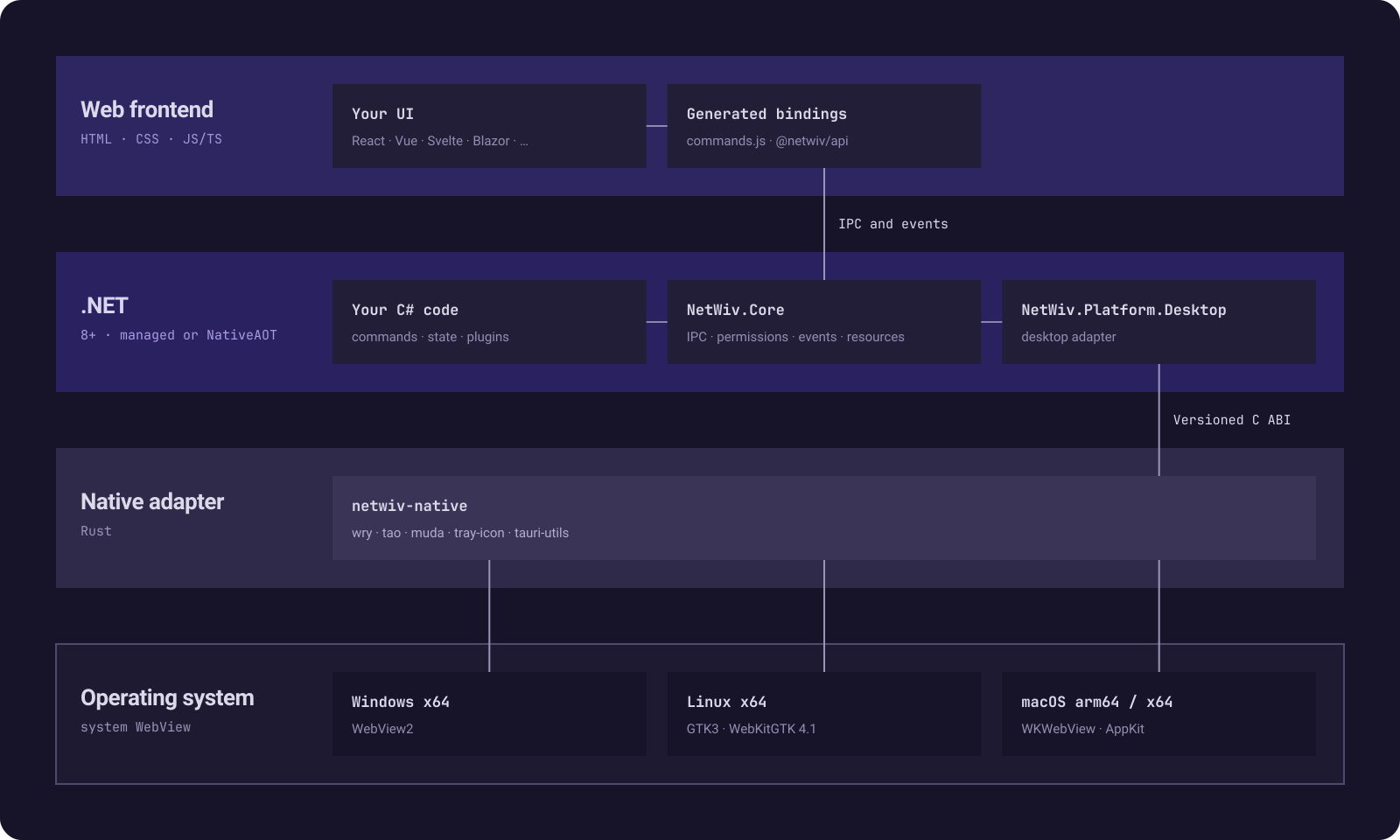
NetWiv uses wry, tao, muda and tray-icon through a versioned C ABI. The C# SDK
owns application policy and tooling; the Rust adapter owns native desktop
objects. Production templates, samples and the conformance host use
NetWiv.Platform.Desktop. Legacy direct platform bindings are archival source,
not an additional supported production backend.
Responsibility boundary
Section titled “Responsibility boundary”The single supported desktop JavaScript/TypeScript entry point is @netwiv/api,
maintained in packages/api. Generated C# command bindings import its core module;
plugin calls use @netwiv/api/plugins/*. Pinned upstream implementations are
privately bundled behind the facade, with no upstream frontend runtime dependency
in consumer applications. Upstream guest tests remain internal comparison fixtures.
Direct Tauri imports and runtime identity helpers are retired. See
frontend SDK.
| .NET | Native Rust adapter |
|---|---|
| Public SDK, source generation, state and plugins | Window and WebView ownership |
| IPC validation, ACL, scope, CSP and assets | OS event loop and UI dispatch |
| Events, channels and managed resources | Native menus, tray and resource handles |
| CLI, configuration, MSBuild and packaging | C ABI and protocol responders |
Core callback targets include a native document generation. Navigation and closure invalidate old command replies, event listeners and captured channels. Native evaluation checks the generation again at execution time. C# validates permissions before dispatching native commands; adopting TAURI® ecosystem libraries does not automatically supply Tauri’s IPC or security policy.
See the native ABI for threading, memory ownership, callbacks and shutdown, and isolation for the supported IPC transport.
Internal module boundaries
Section titled “Internal module boundaries”The native adapter’s modules divide implementation responsibilities without introducing additional runtimes or resource stores:
| Location | Responsibility |
|---|---|
runtime.rs |
Own LocalRuntime, window/WebView/context maps, the event loop, callbacks and ordered shutdown. |
runtime/commands.rs |
Validate submission document identity and route commands to the existing handlers. |
runtime/window.rs, runtime/webview.rs |
Create native objects and implement window/WebView commands, resize, evaluation and reparenting. |
runtime/protocol.rs |
Track document origins and generations, construct the guest bridge and deliver asset responses through Shared. |
runtime/options.rs, runtime/platform.rs |
Decode existing wire values and apply OS-specific window operations. |
runtime/menus.rs |
Attach application/window menus, synchronize accelerators and show context menus. |
runtime/dialogs.rs, dialog/linux.rs |
Track pending Linux dialogs, asynchronous GTK responses, cancellation and document/window/app cleanup. |
resources.rs |
Own the single native RID allocator/table, route resource commands and close resources/channels. |
resources/menus.rs, resources/trays.rs, resources/images.rs |
Implement each resource kind against that same table. |
Child modules are private. Their handlers operate on the existing owner rather
than acquiring another copy of its state. LocalRuntime and native desktop
objects remain on the event-loop thread; only the existing Shared callback,
protocol and event-proxy state crosses threads. Keep document invalidation,
WebView-before-WebContext destruction, resource alias ownership and asset
responder draining in their current order when extending these modules.
The C# CommandGenerator similarly uses private partial declarations:
CommandGenerator.cs wires the incremental pipeline and coordinates output;
Analysis, Diagnostics, Models, Plugins and Emission contain semantic
validation, diagnostic definitions, internal models, plugin discovery and C#
output respectively. These are parts of one compile-time generator, not runtime
services. Frontend binding emission remains in FrontendBindingEmitter.
Generated registrations, serializers, DI invocation scopes and disposal behavior
must remain NativeAOT-safe.
For a structural change, run the native unit tests, generator tests, managed and NativeAOT core tests, and desktop smoke scenarios. Include stale-document replies, reparenting, menu aliases, resource closure and invalid payloads; unchanged ABI declarations alone do not establish unchanged behavior across C#, Rust and JS. See contributing for real-device evidence requirements.
Windows lifecycle behavior
Section titled “Windows lifecycle behavior”Initial WebView focus is best effort. Windows can reject MoveFocus with
0x80070057 when the parent is minimized; this must not discard an otherwise
valid WebView controller. NetWiv creates the controller without initial focus,
then attempts focus unless focus: false was requested. This follows the
upstream WRY fix while retaining
the pinned dependency version. Explicit SetFocusAsync() calls continue to
report native focus errors. Creating a child does not restore a minimized parent.
TAO is pinned to 0.36.0 to include the upstream TaskbarCreated deadlock fix. The window-state lock must be released before taskbar COM calls, which can re-enter the window procedure. Desktop smoke exercises concurrent taskbar recreation messages on its own window, without restarting Explorer.
Builds and delivery
Section titled “Builds and delivery”Framework maintainers build native binaries explicitly for each RID and package
them in NetWiv.Platform.Desktop. Ordinary NuGet consumers do not build the Rust
adapter or download native libraries at startup. Use matching SDK and native
package versions; older native libraries may reject newer run-config fields even
within the same ABI version.
Desktop targets include Windows x64 with WebView2, Linux x64 with GTK3 and WebKitGTK 4.1, and macOS arm64 with WKWebView/AppKit. See macOS for the distinction between implementation and completed validation. Framework development describes native builds and package creation. Support and validation lists remaining acceptance boundaries; native library reuse is not a full Tauri compatibility claim.
TAURI® is a trademark of The Tauri Programme within the Commons Conservancy. WRY and TAO are trademarks of The Tauri Programme within the Commons Conservancy.
NetWiv is an independent project. Its framework, plugins and templates are not affiliated with, endorsed by, or officially approved by The Tauri Programme within the Commons Conservancy.